Savepod × STOQ: how preorders turned a viral moment into $65,000 in revenue
From a Keurig problem to a new product
In late 2019, Yianni was working at Porsche by day, but at home he was struggling with a simple problem: his Keurig coffee pods. The taste wasn’t great, the pods were expensive, and every use created plastic waste. He wanted something better, and that’s where the idea for Savepod began: a reusable system for making fresh coffee pods at home.
Before building the product, Yianni wanted to know whether other Keurig users felt the same way. He started talking to people without telling them about his idea and found a consistent pattern. People loved the convenience of their Keurig, but complained about the cost of pods, plastic waste, and taste.
He then looked at reusable pods already on the market and found another problem. The metal mesh filters were inconvenient to clean, and leftover coffee could sit inside the pod between uses.
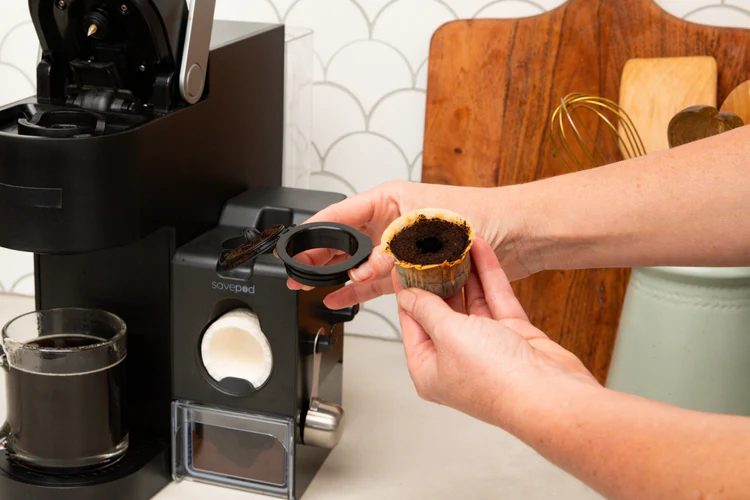
That led to the idea behind Savepod: a reusable ring paired with a paper filter, giving customers a way to make their own coffee pods without having to clean a reusable mesh filter after every use.
Like many first-time founders, Yianni’s journey wasn’t linear. He started with prototypes and eventually launched a Kickstarter campaign in 2021. He taught himself to draft a 30-page patent and edited the Kickstarter video himself on iMovie.
The campaign raised $213,000 in 30 days. But raising the money was only the beginning.
Turning a successful Kickstarter into a real product
The Kickstarter campaign created a new challenge: turning a prototype into something that could actually be manufactured and shipped at scale.
What followed was roughly two years of manufacturing challenges, supply chain problems, product revisions, and fulfillment pressure. As shipments fell behind, some backers became increasingly frustrated.
“People were very, very, very angry that I was late, to the point where I was getting harassed badly,” Yianni recalled. “Luckily, I have thick skin, so I was okay. But not everybody does.”
Eventually, Savepod made it through the manufacturing process and had a finished product ready to sell.
That experience also gave Yianni a very different perspective on preorders. He had learned that taking orders before a product is ready can create a very different set of problems from taking orders for a product that is already manufactured and simply temporarily out of stock. That distinction would become important later.
An unexpected viral moment emptied the inventory
Savepod had been posting regularly on Instagram, TikTok, and YouTube, usually seeing a few hundred or a thousand views.
Then one Instagram video took off.
Within 24 hours, it reached 1 million views. The video continued spreading and eventually reached around 20 million views. Savepod's Instagram following grew from roughly 1,000 to 30,000. The demand translated quickly into sales. Savepod sold out its available inventory of 5,000 units in 10 days.
The challenge was what happened next.
Website traffic remained high, but there was no inventory left to sell. Customers were still arriving at the store, and the next inventory batch wasn't ready. Yianni knew he needed a way to keep capturing that demand.
“Our website traffic was high and I said, I need to create pre-orders now so that we can continue capturing sales.”
Looking for a way to keep selling
Yianni started looking for a Shopify app that could handle preorders. STOQ was the first app he tried.
The setup involved a few issues around fulfillment, Shopify, Amazon, and inventory syncing. Yianni wasn't even sure all of the issues were related to STOQ.
What mattered was how quickly he could get help.
He reached out through STOQ's chat and got a response right away. The team got on a call with him and helped resolve the issue so he could get the preorder setup working properly.
“The support that I got that enabled me to quickly solve my problem and get the pre-order button set up on my website properly.”
For Yianni, that experience became an important part of why he recommends STOQ to other Shopify merchants.
$65K in preorder revenue while waiting for inventory
The preorder button became the main thing Savepod used STOQ for. After selling out around late November, Savepod continued accepting preorders while waiting for its next inventory batch. During that period, Savepod captured approximately 1,000 preorders, generating $65,000 in preorder revenue while inventory was unavailable.
For Yianni, the biggest business impact was cash flow.
“The number one thing it's allowed us to do is capture these sales before having inventory to allow for cash flow to fund our business.”
Instead of stopping sales until inventory returned, Savepod could continue accepting orders from customers who were willing to wait.
Giving customers another way to stay connected
Not every customer wanted to preorder.
Some preferred to wait until the product was back in stock. Savepod used STOQ's back-in-stock alerts to capture that demand. More than 7,000 people had subscribed to Savepod's back-in-stock alerts.
At the time of the interview, Savepod had not yet sent the notification. The company had received inventory again and was waiting to optimize a few things before notifying the subscribers.
That meant customers had two options when inventory wasn't available: preorder if they wanted to secure the product, or sign up for a back-in-stock notification and wait.
“Not everybody wants to pre-order, but some people do want to pre-order.”
What Yianni learned about preorders
Savepod's Kickstarter experience had taught Yianni that preorders can become difficult when a product is still being developed.
He now draws a clear distinction between the two situations.
“I wouldn't recommend that somebody takes a lot of pre-orders before they've even like developed the product.”
But once a product is ready and the company knows it can manufacture it, he sees preorders differently.
“Once you have a product and you know you're able to manufacture it, I 100% recommend pre-orders on something like Shopify.”
That was the situation Savepod found itself in.
The product was ready. The manufacturing process was established. Demand was already proven. The problem was simply that inventory couldn't keep up.
Keep capturing demand when inventory runs out
Savepod couldn't predict that an Instagram video would eventually reach around 20 million views. But when demand suddenly exceeded inventory, the company had a choice: stop selling or find a way to keep capturing that demand.
STOQ gave Savepod that option.
The company captured $65,000 in preorder revenue, approximately 1,000 preorder units, and more than 7,000 back-in-stock subscribers while managing the inventory gap.
For Yianni, the lesson is straightforward:
“If you don't have STOQ downloaded and you're not taking pre-orders, then you're leaving a lot of money on the table because that consumer may never come back to your website again.”
For Savepod, an inventory shortage didn't have to mean the end of the customer journey. It became a period when the company could continue capturing demand while waiting for inventory to catch up.